If you have watched the UFC lightweight division over the last decade, you have witnessed a specific type of dominance that feels almost inevitable. It isn’t just about takedowns or brute strength; it is about a feeling of complete helplessness imposed on elite fighters. At the center of this dominance is a technique that has become synonymous with Khabib Nurmagomedov and Islam Makhachev: the Dagestani Handcuff.
This technique, technically known as a wrist ride or a two-on-one wrist control from a ride position, has fundamentally changed how grappling is approached in modern MMA. It is not a submission hold that ends the fight in seconds, but a control position that drains the opponent’s gas tank, breaks their will, and opens them up to vicious ground-and-pound. For fans watching from Estonia or anywhere else in the world, understanding this move reveals the hidden layer of chess being played on the canvas.
What is the Dagestani Handcuff?
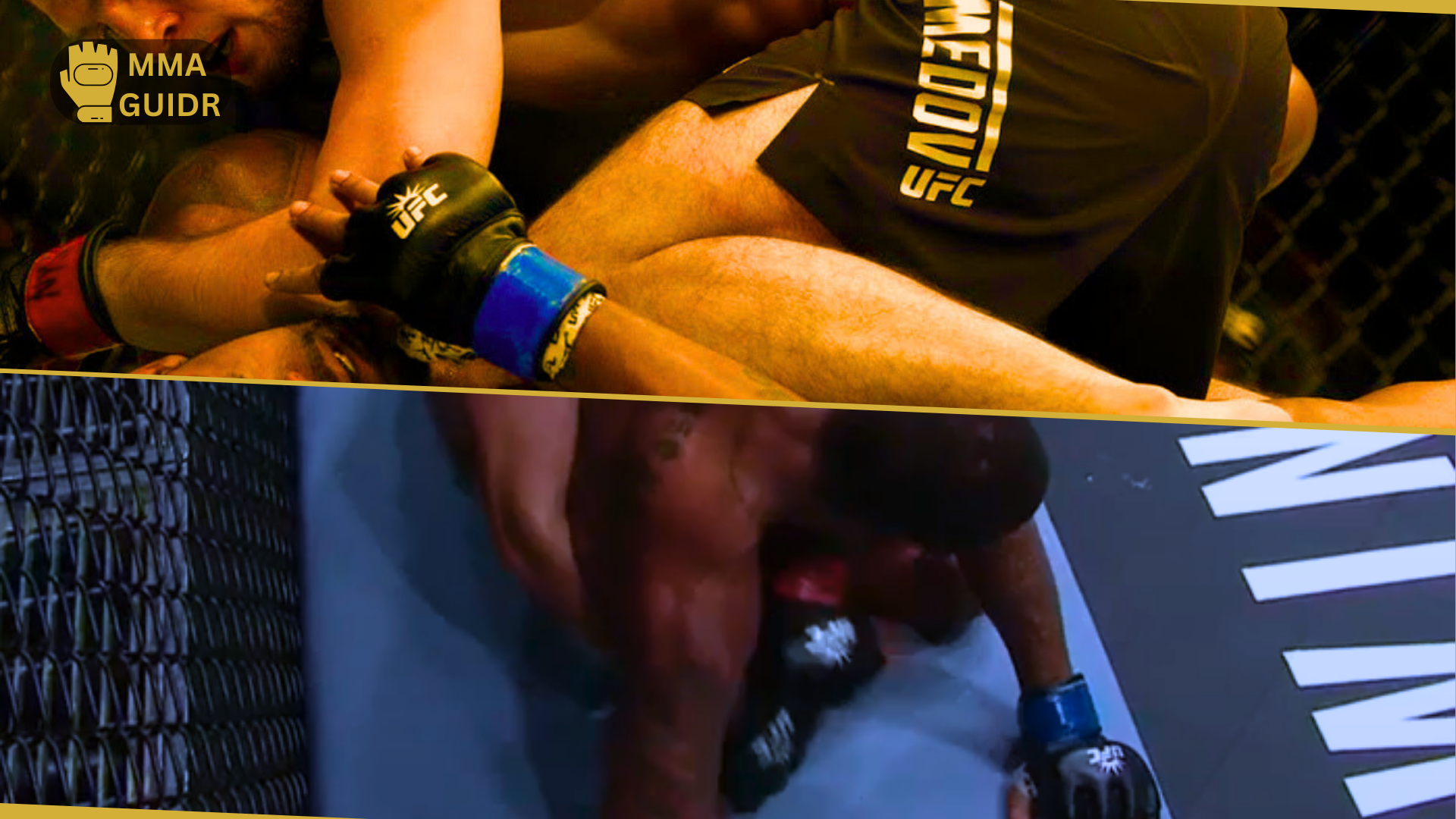
The “Dagestani Handcuff” is a grappling position where the top fighter secures the opponent’s wrist—usually the one on the same side they are riding—and pins it behind the opponent’s back or traps it against their own body. This effectively creates a situation where the opponent is fighting with three limbs against four, but the leverage makes it feel like even less.
Unlike traditional wrestling rides that focus purely on pinning shoulders to the mat for a referee’s count, this technique is adapted for the cage. The goal is to remove the opponent’s “posts” (the arms they use to stand up). When you take away a fighter’s ability to post a hand on the mat, they cannot build the base necessary to stand back up. They are stuck, carrying the full weight of the top fighter while their arm is manipulated into a powerless position.
The Mechanics of Misery
To execute this technique, a fighter like Khabib Nurmagomedov typically follows a rigorous sequence:
- The Takedown: First, the fight hits the mat. This often happens against the fence, where the cage prevents the opponent from scooting away.
- The Ride: The top fighter establishes a ride position, often creating a “triangle” with their legs around the opponent’s legs to eliminate movement.
- The Wrist Collection: This is the crucial moment. As the opponent tries to post their hand to stand up, the top fighter snatches the wrist.
- The Handcuff: The wrist is then pulled behind the opponent’s back. The top fighter might use their own hand to hold it there, or in deep variations, transfer the wrist to their other hand, freeing up their primary hand to rain down punches.
Once the wrist is secured behind the back, the bottom fighter’s shoulder is rotated internally, a position that is naturally weak and uncomfortable. To escape, they must rotate their body, but the top fighter’s weight prevents exactly that rotation.
Why It Breaks Fighters: The Psychology of Control
Physically, the Dagestani Handcuff is exhausting. Psychologically, it is devastating. MMA fighters are trained to explode, scramble, and create space. This technique nullifies all of those reactions.
Recall the famous fight between Khabib Nurmagomedov and Michael Johnson at UFC 205. While mauling Johnson, Khabib was famously heard telling him to “give up” because he “needs to fight for the title.” The physical mechanism allowing Khabib to have a casual conversation while destroying a world-class striker was the complete control offered by the wrist ride. Johnson’s arm was trapped, his hips were flattened, and he had no option but to absorb damage.
This creates a feeling of “drowning” that many opponents of the Dagestani style describe. It is a slow-motion defeat. The panic sets in not because of a sudden pain, but because of the realization that nothing you do is working. For a professional fighter who has trained their whole life to be dangerous, being rendered harmless is the ultimate mental blow.
Evolution: From Khabib to Islam
While Khabib popularized the term among commentators, his successor, current champion Islam Makhachev, has refined it. Islam’s application of the handcuff often blends seamlessly with his judo background. He is perhaps even more patient than Khabib, using the wrist control to set up cleaner submissions rather than just ground-and-pound.
In his bout against Charles Oliveira at UFC 280, Islam didn’t just rely on the handcuff; he used the threat of it to force Oliveira into bad transitions. When Oliveira worried about his wrists being pinned, he exposed his neck, leading to the arm-triangle choke finish. This shows the evolution of the technique: it is no longer just a holding position, but a funnel that guides opponents into submissions.
Key Differences in Application
Observers often note that Khabib’s style was more chaotic and violent, using the handcuff to smash opponents. Islam’s style is often described as more surgical. He uses the wrist ride to systematically disable defenses before moving to a submission. Both, however, rely on the same fundamental principle: control the wrist, control the body.
Counters and Defenses: Is It Unstoppable?
No technique in MMA is truly unstoppable, but the Dagestani Handcuff is notoriously difficult to counter once it is fully locked in. The best defense is early prevention. Fighters training to face this style focus on:
- Hand Fighting: The moment the top fighter reaches for a wrist, the bottom fighter must fight the hands aggressively. You cannot let them settle their grip.
- Building a Base Early: If you wait until you are flattened out to try and stand, it is too late. Escapes must happen immediately after the takedown.
- The “Switch”: Some wrestlers use a maneuver called a switch to attack the top fighter’s arm, but this is risky against high-level grapplers who expect it.
We saw glimpses of successful defense in the first fight between Islam Makhachev and Alexander Volkanovski. Volkanovski, a shorter fighter with a lower center of gravity, constantly fought the hands and refused to accept the flat position. He didn’t just survive; he managed to escape positions that would have finished most lightweights. This proved that with elite cardio and constant, disciplined hand-fighting, the handcuff can be resisted.
The Global Impact on MMA Training
The success of the Dagestani Handcuff has forced every major MMA gym in the world to adapt. Camps in the US, Brazil, and Europe (including growing scenes in places like Estonia) are now incorporating “Dagestani rides” into their curriculum. It has shifted the meta of MMA grappling from “jiu-jitsu guard play” to “wrestling rides and top control.”
For aspiring fighters, learning this technique is no longer optional; it is a requirement. Whether you use it or need to defend against it, the wrist ride is now a fundamental part of the sport’s vocabulary. It represents a return to the “martial” in mixed martial arts—a technique designed not for flashiness, but for total, uncompromising effectiveness.
If you are following the local fight scene or looking for news on major events, keep an eye on MMA news for updates on fighters who might be employing these high-level grappling strategies. The sport is evolving fast, and the wrist ride is currently steering the ship.
FAQ: The Dagestani Handcuff
Is the Dagestani Handcuff legal in all MMA organizations?
Yes, the technique is perfectly legal under the Unified Rules of MMA. It is a grappling control hold and does not involve manipulating small joints (like fingers) or striking illegal areas. It is simply a highly effective way to use leverage and weight distribution.
Can this technique be used for self-defense?
Absolutely. In a self-defense situation, controlling an attacker’s hands is paramount to preventing them from striking you or reaching for a weapon. The Dagestani Handcuff allows you to neutralize a threat without necessarily causing severe injury, making it a valuable tool for de-escalation once the fight hits the ground.
How long does it take to learn the Dagestani Handcuff?
While the basic mechanics can be learned in a few weeks of consistent grappling training, mastering the nuance of weight distribution and balance takes years. Fighters like Khabib and Islam have been drilling these positions since childhood. To use it effectively against a resisting opponent requires a deep understanding of body mechanics.
Is it better than Brazilian Jiu-Jitsu (BJJ)?
It is not better or worse; it is different. Traditional BJJ often focuses on fighting off your back (guard), whereas the Dagestani style emphasizes top control and never accepting the bottom position. In modern MMA, the most successful fighters combine both: using the Dagestani ride to control from the top and BJJ to finish submissions.