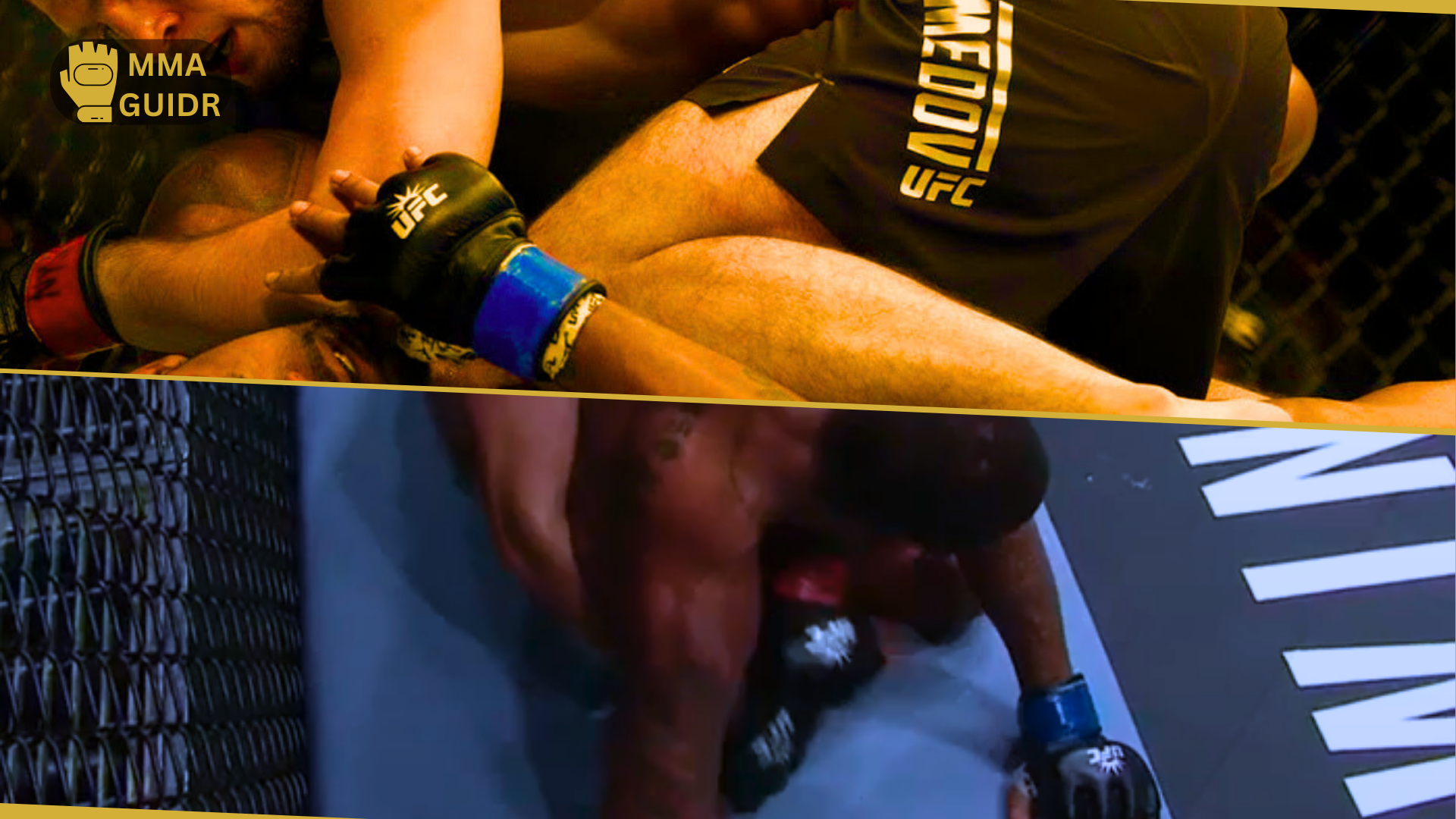
The Anatomy of the “Long-Man” Submission
In the high-stakes chess match of mixed martial arts, few moves are as visually distinctive and devastating as the D’Arce choke MMA fighters have come to fear. It is a technique that turns a wrestler’s greatest instinct—the underhook—into their sudden demise. If you have ever watched a fighter shoot for a takedown, only to find themselves gasping for air with their own arm trapped against their neck seconds later, you have witnessed the D’Arce in action.
While the rear-naked choke remains the king of statistical finishes, the D’Arce holds a special place in the arsenal of the lanky, long-limbed striker. It is the signature weapon of fighters who don’t just grapple to survive, but grapple to create chaos. From the blood-soaked mats of Tony Ferguson’s prime to the modern-day precision of Kevin Holland, this choke has evolved from a niche grappling trick into a staple of elite MMA.
But why is it so effective? And why does it seem to be the exclusive property of fighters with wingspans that would make an albatross jealous? To understand the D’Arce, we have to look past the squeeze and into the mechanics of leverage, length, and the evolution of the sport itself.
The Mechanics: How the D’Arce Choke Works
At its core, the D’Arce (or Brabo choke) is an arm-triangle variation. Unlike the standard arm-triangle (Kata Gatame), which is typically finished from the top mount or side control, the D’Arce is unique because of its entry point. It is almost always set up from a front headlock position, often when an opponent is turtled or diving for a takedown.
The “Blade” Entry
The mechanic that separates the D’Arce from its cousins, the Anaconda choke and the Guillotine, is the threading of the arm. For a D’Arce:
- The Thread: The attacking fighter shoots their arm under the opponent’s armpit and threads it across the neck to the far side.
- The Lock: The hand of the threading arm grabs the bicep of the other arm (creating a figure-four grip).
- The Torque: The attacker then sprawls or rolls, using their chest to drive the opponent’s trapped shoulder into their own neck, cutting off blood flow to the carotid arteries.
This creates a “blood choke” (strangle) rather than an “air choke.” When applied correctly with the right leverage, unconsciousness can occur in less than 10 seconds.
The History: From Renzo Gracie to the Octagon
The move is named after Joe D’Arce, a third-degree Brazilian Jiu-Jitsu black belt under the legendary Renzo Gracie. However, D’Arce himself has remained humble about the name, often crediting its actual invention to others, potentially pointing toward German Luta Livre practitioners like Björn Dag Lagerström who were using similar “inverted arm-triangles” in the 90s.
Regardless of who invented it, Joe D’Arce popularized it in grappling competition. He used his long arms to slide the choke in from angles that opponents didn’t think were dangerous. The MMA world took notice. As wrestling became dominant in the UFC, the D’Arce emerged as the perfect “anti-wrestling” weapon. When a wrestler shoots a double-leg or digs for an underhook, they naturally lift their arm—literally opening the door for the D’Arce entry.
The “Long-Limb” Advantage: Why Reach Matters
You will often hear commentators claim that a fighter has “D’Arce arms.” This isn’t just filler commentary; it is simple physics. The D’Arce requires the attacker to thread their arm all the way through the opponent’s armpit and across their neck to lock onto the opposite bicep.
For a fighter with short arms, this is a struggle. They have to compress the opponent’s body significantly to make the grip connect. For a fighter with long arms, the reach allows them to:
- Lock Early: Secure the figure-four grip before the opponent even realizes the danger.
- Finish from Bad Angles: A long fighter can finish a D’Arce even if their chest isn’t perfectly aligned, simply because they have the leverage to torque the neck from distance.
- Catch Transitions: Long limbs allow for “snatching” the neck during scrambles, a trademark of fighters like Tony Ferguson.
Case Study 1: Tony Ferguson — The Boogeyman’s Blade
No discussion about the darce choke mma history is complete without mentioning Tony “El Cucuy” Ferguson. For a decade, Ferguson was the nightmare of the 155lb division, and his 76.5-inch reach was a massive part of that success.
Ferguson didn’t use the D’Arce as a static submission; he used it as a flow. He famously finished Mike Rio, Edson Barboza, and Lando Vannata with the technique. The Vannata finish was particularly illustrative. After a wild scramble where he was nearly knocked out, Ferguson used his cardio and length to snap Vannata down. As Vannata tried to recover, Ferguson’s long arm snaked through, and the tap came moments later.
Ferguson’s style showed that the D’Arce wasn’t just a counter—it was a weapon of attrition. He would club opponents with elbows, force them to panic-wrestle, and then slide in the choke when they were desperate. Although Ferguson left the UFC in 2025, his blueprint on how to weaponize length remains essential study material for young fighters.
Case Study 2: Vicente Luque — The Silent Assassin
Until recently, Vicente Luque held the undisputed title of the “D’Arce King” of the UFC. With four D’Arce choke finishes on his record, Luque proved that you don’t need to be a erratic wildman like Ferguson to use the move; you just need precision.
Luque’s finish of Tyron Woodley at UFC 260 was a masterclass. After rocking the former champion with strikes, Luque didn’t recklessly swarm. He waited for Woodley to clinch, knowing the desperate underhook was coming. The moment Woodley reached, Luque clamped the D’Arce. His squeeze is notoriously tight, often forcing taps before he even hits the ground.
Case Study 3: Kevin Holland — The New King?
In a poetic twist of fate, the mantle may have been passed. Kevin Holland, boasting a ridiculous 81-inch reach for the welterweight/middleweight division, has a complicated relationship with the D’Arce.
At UFC 279 in 2022, Holland was famously steamrolled and submitted by Khamzat Chimaev using—you guessed it—a D’Arce choke. It was a harsh lesson in the mechanics of his own physical advantages being used against him. But Holland is a quick learner.
Fast forward to July 2023 at UFC 291, Holland used that massive wingspan to wrap up Michael Chiesa, a high-level grappler in his own right. But the true “passing of the torch” occurred recently at UFC 316 in June 2025. In a matchup that hardcore fans had dreamed of, Holland faced Vicente Luque. In the second round, after hurting Luque on the feet, Holland snatched a D’Arce choke in a scramble. To submit the record-holder with his own signature move was a statement: The long-man game has a new leader.
How to Defend the D’Arce (If You Can)
Understanding the attack is the first step to defense. If you find yourself in a front headlock against a long opponent, remember these survival tips:
- Fight the Hands: You must prevent the hands from connecting. Once the figure-four grip is locked, your chances of escape drop to near zero.
- Go Flat: The D’Arce requires the attacker to turn you onto your side or “crunch” you. If you can flatten your hips and chest to the mat (going belly down), you kill the angle.
- The “Answer the Phone” Defense: Putting your hand to your ear can create just enough space to prevent the choke from sinking into the arteries, buying you time to scramble.
The Future of the D’Arce
As MMA evolves, fighters are becoming better at defending basic submissions like the armbar and guillotine. However, the D’Arce continues to thrive because it punishes the most common reaction to striking pressure: wrestling. As long as fighters shoot for takedowns to escape damage, the D’Arce will be there waiting for them.
For fans in Europe and specifically Estonia, keeping an eye on long, rangy prospects in local circuits is key. If you see a fighter with arms that hang to their knees, watch for the front headlock. You might just see the next Tony Ferguson in the making.
For more deep dives into grappling techniques and fighter analysis, check out other breakdowns in the MMA News sections.
FAQ: The D’Arce Choke
Is the D’Arce choke dangerous?
Yes, like all blood chokes (strangles), it cuts off blood flow to the brain. If a fighter does not tap, they can fall unconscious in 5-10 seconds. However, it is generally considered safer than joint locks (like kimuras or heel hooks) because it does not cause permanent structural damage if the referee stops the fight promptly.
What is the difference between a D’Arce and an Anaconda choke?
The main difference is the entry and lock. In a D’Arce, the arm is threaded under the armpit and locked on the neck side. In an Anaconda choke, the arm is threaded through the neck and locked on the armpit side. A simple rule of thumb: D’Arce is usually finished by dropping to the side, while the Anaconda often involves rolling the opponent (the “gator roll”).
Can short fighters use the D’Arce choke?
Yes, but it is much harder. Short-limbed fighters (like Alexander Volkanovski) often favor the Guillotine or the standard Arm-Triangle, as the D’Arce requires a reach that allows the threading arm to go deep enough to secure the bicep grip without losing leverage.
Who has the most D’Arce choke wins in UFC history?
As of early 2026, Vicente Luque holds the record with 4 D’Arce choke finishes. Tony Ferguson is close behind with 3. Kevin Holland is rapidly climbing this list, proving the technique’s effectiveness for rangy fighters.
How long does it take to learn the D’Arce choke?
The basic mechanics can be learned in a few Jiu-Jitsu classes, but mastering the “feel”—knowing exactly when to slide the arm in during a sweat-slippery MMA fight—takes years of practice. It requires high-level timing to catch an opponent in the transition between standing and the ground.