For years, the narrative in Mixed Martial Arts was simple: Muay Thai is for striking, Wrestling is for control, and Brazilian Jiu-Jitsu is for finishing. Traditional Martial Arts (TMA) like Karate were often scoffed at, relegated to 1980s action movies rather than serious cage fighting. The upright, rigid postures of traditional dojos seemed ill-equipped for the grit of the Octagon.
Then came the Dragon.
When Lyoto Machida captured the UFC Light Heavyweight Championship in 2009 without losing a single round in his career up to that point, the script flipped. Suddenly, the wide, bladed stance wasn’t a liability; it was a puzzle that no one could solve. The “Machida Era” may have been short-lived, but it opened the door for a new generation of strikers who utilize the “Blitz” style to devastating effect.
Today, fighters like Stephen Thompson and former champions like Conor McGregor have proven that the principles of Karate—specifically distance management and linear bursting—are not just effective, but essential in the modern meta of MMA. This deep dive analyzes why the wide stance works, the mechanics of the blitz, and the fighters who mastered it.
The Mechanics of the Bladed Stance
To understand why Karate works in MMA, you first have to understand the stance. Most Muay Thai and Boxing stances are relatively square. The shoulders and hips face the opponent to allow for powerful rotation on hooks, crosses, and roundhouse kicks. This also allows for checking leg kicks efficiently.
The Karate stance (specifically from Shotokan and Kempo styles) is “bladed.” The fighter stands sideways, with their lead shoulder pointed directly at the opponent. This seemingly limits the weapons available from the rear hand, but it offers three distinct advantages that shatter traditional striking ranges.
1. The Distance Illusion
In a bladed stance, the target is smaller. By turning sideways, a fighter reduces the surface area available for the opponent to hit. More importantly, it extends the lead leg and lead hand closer to the opponent while keeping the head and body further away. This creates a “safe zone” where the Karate fighter can land jabs or side kicks, but the opponent’s counter-fire falls short.
2. The Linear “Blitz”
Speed in fighting is often about displacement. Traditional boxers shuffle; Karatekas bounce. This rhythmic bouncing isn’t just for show—it loads the legs like springs. When a fighter like Robert Whittaker decides to attack, he doesn’t step; he explodes. This linear burst covers huge distances in a fraction of a second, often catching opponents while they think they are safely out of range.
3. The Side Kick as a Jab
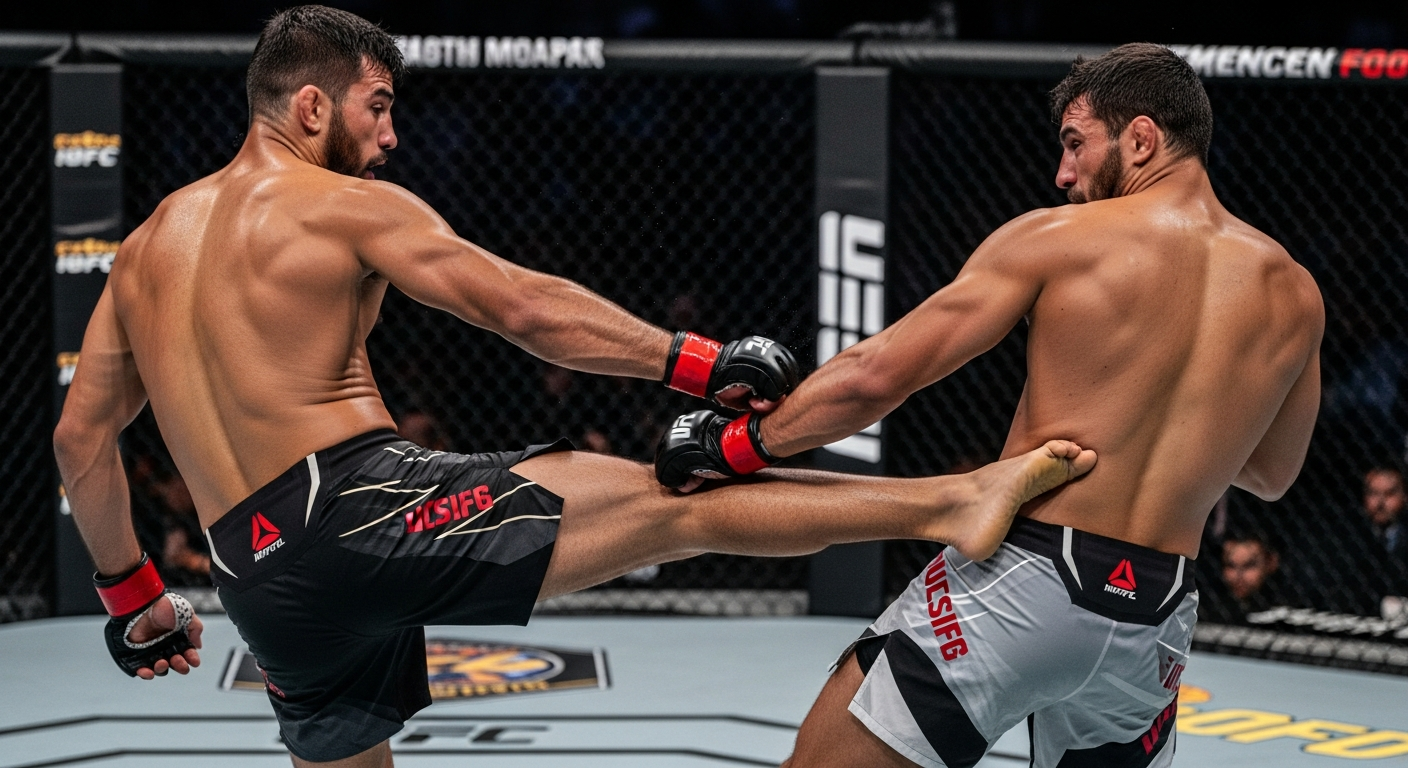
If the jab is the most important weapon in boxing, the lead leg side kick is the king of the Karate arsenal. It acts as a long-range stiff arm. When an aggressive brawler tries to close the distance, a well-placed side kick to the knee or gut stops their momentum dead. It frustrates pressure fighters, forcing them to reset and often walk blindly into the next blitz.
Case Study: Lyoto Machida and the Art of Elusiveness
Lyoto Machida didn’t just use Karate; he adapted it. His background in Sumo wrestling gave him a unique center of gravity, allowing him to stay upright even when blitzing forward. But his striking defense was pure Shotokan.
Machida’s game was built on frustration. He would stay on the absolute edge of his opponent’s range. When they stepped forward to hit him, he was already gone, circling out or stepping back. When they hesitated, he would blitz with a straight left down the pipe. This style created a psychological trap: opponents became afraid to attack because they would miss, but afraid to wait because they would get hit.
His knockout of Rashad Evans is the textbook example. Machida waited for Evans to overcommit, then unleashed a flurry of straight punches that floored the champion. It wasn’t about raw power; it was about precision and the manipulation of distance.
Case Study: Stephen “Wonderboy” Thompson’s Distance Trap
If Machida was the prototype, Stephen “Wonderboy” Thompson is the refined model. With a background in Kempo and Kickboxing, Thompson’s stance is even wider and his hands often dangerously low.
Thompson relies entirely on distance management for defense. He doesn’t keep a high guard because he trusts his ability to slide out of range by an inch. His “bouncing” rhythm mesmerizes opponents. They try to time the bounce, but Thompson breaks the rhythm, switching from a retreat to an attack instantly.
The Question Mark Kick: Thompson’s wide stance allows him to throw kicks from the lead leg without switching his hips. He can lift his lead knee and threaten a side kick to the body, only to whip the foot over the top for a head kick. Because the hip motion looks identical for both techniques, the opponent has almost no time to react.
Conor McGregor: The Karate Influence
While not a traditional Karateka, Conor McGregor rose to fame using the very same principles. In his featherweight run, McGregor adopted a wide, bladed stance heavily influenced by Taekwondo and Karate mechanics.
McGregor used this stance to maximize the reach of his left hand (the “Celtic Cross”). By standing bladed, he could lean his upper body in to bait a strike, then pull back and fire his left hand over the top. His knockout of Jose Aldo was the culmination of this style—using distance and timing to land a counter shot while moving backward, a maneuver that requires the balance and spacing of that wide stance.
The Risks: Why Isn’t Everyone Doing It?
If the bladed stance is so effective, why doesn’t every fighter adopt it? The answer lies in the “Shogun Blueprint.”
In their first fight, Mauricio “Shogun” Rua exposed the fatal flaw of the Karate stance: Leg Kicks. When you stand sideways with your weight distributed for movement, your lead leg is exposed. It is difficult to “check” (block) a leg kick from a bladed stance because turning the shin outward requires squaring the hips, which takes too much time.
Shogun hammered Machida’s legs, taking away his mobility. Without movement, a Karate fighter is a sitting duck. The wide stance also opens up the risk of takedowns if the fighter isn’t careful. While the distance helps avoid the initial shot, once a wrestler gets past the hands, the wide base can sometimes be harder to sprawl from quickly compared to a square, wrestling-ready stance.
Modern Adaptations: The Hybrid Style
The modern era has seen a hybridization of the style. Fighters like Henry Cejudo, an Olympic wrestler, adopted a wide Karate stance later in his career. Why? Because the wide stance creates a longer barrier. Cejudo used it to manage distance against taller strikers, forcing them to over-extend, which then allowed him to enter for takedowns.
Robert Whittaker uses the “Blitz” entry but finishes with Boxing combinations. He lunges in like a Karateka to close the gap, then squares up to unload hooks and uppercuts before exiting safely. This “Blitz-into-Box” approach minimizes the risk of the wide stance while keeping the benefit of rapid entry.
Conclusion: It’s Not the Art, It’s the Application
The debate between “Traditional” and “Modern” martial arts is dead. The reality is that effective fighting steals from everywhere. The wide, bladed stance of Karate offers unparalleled distance control and blitzing speed, but it demands high-level footwork and cardio to maintain.
Fighters who master this style control the geometry of the fight. They dictate when exchanges happen. Whether it’s the elusive counter-fighting of Machida or the rhythmic offense of Wonderboy, the Karate stance has earned its place as a dominant, evergreen strategy in high-level MMA.
Frequently Asked Questions
1. Is Karate effective in a street fight?
Yes, specifically the concepts of distance management and the “one strike, one kill” mentality. However, the sport-specific bouncing of point karate might be dangerous on uneven pavement. The ability to control range is universally useful in self-defense.
2. Why don’t more MMA fighters use the wide stance?
It requires a specific body type and immense cardio. It also leaves the lead leg vulnerable to low kicks (Calf kicks), which have become very popular in modern MMA. Mastering the stance takes years of specialized training that many wrestlers or boxers don’t have.
3. What is the difference between Shotokan and Kyokushin in MMA?
Shotokan (Machida, Thompson) focuses on long-range, linear movement, and point-scoring strikes (Blitz). Kyokushin (Georges St-Pierre) is a full-contact style that emphasizes close-range power, body conditioning, and fighting in the pocket. Shotokan is about not getting hit; Kyokushin is about absorbing damage to deliver it.
4. Can you learn the “Blitz” without a Karate background?
Yes. Many fighters learn the mechanics of the blitz—pushing off the rear foot to cover distance explosively—through MMA striking coaches. However, those with a lifelong background in Karate often have a more natural, fluid rhythm that is hard to replicate.