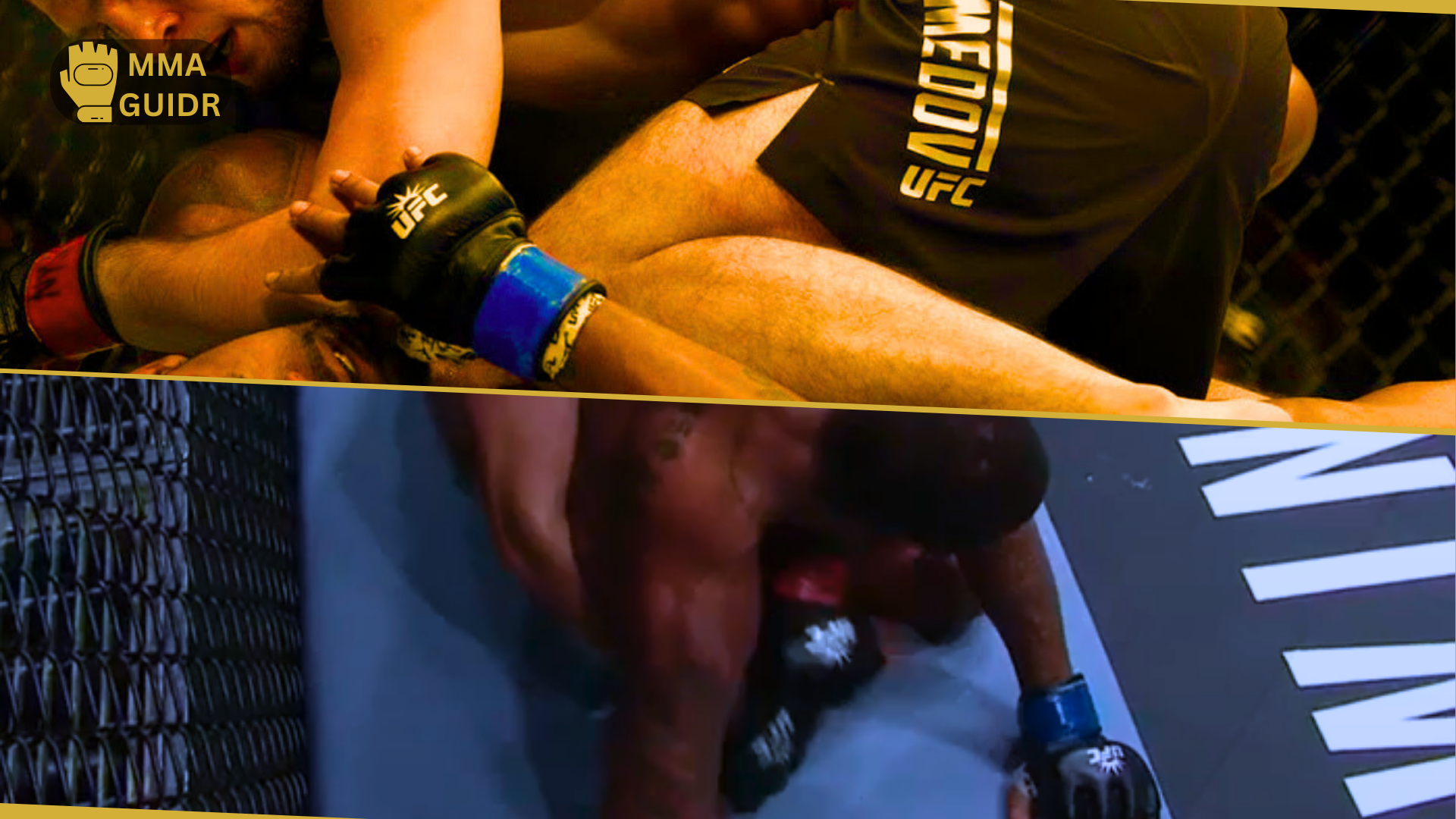
When you hear the word “Kimura,” you likely picture a shoulder lock—a definitive, bone-breaking end to a fight. You might think of Masahiko Kimura breaking Helio Gracie’s arm in 1951, or Frank Mir snapping Antonio Rodrigo Nogueira’s humerus at UFC 140. But in modern MMA, the Kimura has evolved into something far more complex and dangerous than just a submission hold. It has become a system.
The “Kimura Trap” is a concept that treats the double-wrist lock grip not as the end of the chain, but as the beginning. It is a positional anchor that allows a fighter to control an opponent’s posture, counter takedowns, sweep from the bottom, or take the back. For fighters like Khabib Nurmagomedov and Kazushi Sakuraba, this grip was a Swiss Army knife of grappling control.
This deep dive will analyze the mechanics of the Kimura Trap, its historical evolution from Judo to MMA, and how modern elites use it to dominate fights without ever necessarily finishing the submission.
The History: From “Ude-Garami” to the “Gracie Hunter”
To understand the trap, we must first respect the lock. The technique was originally known in Judo as Ude-Garami (entangled armlock). It gained its famous moniker after the legendary judoka Masahiko Kimura used it to defeat Helio Gracie, the godfather of Brazilian Jiu-Jitsu, in a 1951 super-fight in Brazil. For decades, it was viewed primarily as a submission: you get the grip, you rip the arm behind the back, and you get the tap.
The paradigm shifted in the late 1990s and early 2000s with the rise of Kazushi Sakuraba. Known as the “Gracie Hunter,” Sakuraba didn’t just use the Kimura to submit people; he used it to scramble. He would lock the grip from a standing position to defend takedowns, dragging opponents to the canvas. He would use it to spin underneath fighters and take their back. Sakuraba showed the world that the Kimura grip was a handle on the opponent’s entire body, not just their arm.
The Mechanics of the Trap
At its core, the Kimura Trap relies on the “Figure-Four” grip: one hand grabs the opponent’s wrist, and your other hand grabs your own wrist. This creates a closed loop that is incredibly difficult to break. But the “trap” aspect comes from how you use your bodyweight.
- Shoulder Control: By cranking the arm behind the back (the “police hold” position), you force the opponent’s shoulder to rotate. Where the shoulder goes, the body must follow. If they don’t turn, their shoulder breaks. If they do turn, they expose their back or give up a sweep.
- The T-Position: A key concept in the trap is keeping your chest perpendicular to the opponent’s side (forming a “T”). This prevents them from posturing up and allows you to use your legs to hook theirs, setting up sweeps.
- The Dilemma: The Kimura Trap forces a “damned if you do, damned if you don’t” dilemma. If the opponent defends the armlock by grabbing their shorts or clasping their hands, they are safe from the submission but stuck in the position. The attacker can then use this static connection to move around them—literally using the opponent’s arm as a pivot point to take the back.
Application 1: The Ultimate Takedown Counter
One of the most effective uses of the Kimura Trap in modern MMA is as a counter to wrestling. When an opponent shoots for a single-leg or double-leg takedown, their head is usually on the outside of your hip, and their arms are wrapped around your legs. This leaves their far arm exposed.
Fighters like Charles Oliveira are masters of this. As the opponent drives forward, Oliveira will overhook the arm and lock the Kimura grip. Instead of trying to sprawl and defend the takedown traditionally, he will sit back and sacrifice the takedown. This might sound risky, but because he has the Kimura grip, he can immediately use the momentum to flip the opponent over (the “Sumi Gaeshi” sweep) or threaten the submission so severely that the wrestler has to abandon the takedown to save their arm.
Case Study: Khabib Nurmagomedov
While known for his Sambo and wrestling, Khabib often used the Kimura grip as a threat to improve his position. In his fight against Michael Johnson at UFC 205, Khabib found himself in bottom position briefly. He immediately isolated an arm. While he eventually finished with the Kimura, the threat of it forced Johnson to defend defensively, allowing Khabib to pin him against the cage, trap his legs, and rain down his legendary ground-and-pound.
Application 2: The Sweep and Back Take
The beauty of the Kimura Trap is that it turns a defensive guard position into an offensive cycle. A common scenario involves the “Half Guard” position. If you are on the bottom in half guard, you can sit up and lock a Kimura grip on the opponent’s far arm.
Once the grip is locked, two main paths open up:
- The Sweep: You fall back and place a “butterfly hook” (your foot) inside their thigh. Using the leverage of the arm grip, you lift them with your leg and flip them over your head. This is often called the “Kimura Sweep” or “Hip Bump Sweep” variation.
- The Back Take: If the opponent defends the sweep by widening their base, they often leave a gap between their elbow and ribs. You can slide your hips out, insert a hook, and spin around to their back, all while maintaining the Kimura grip to control their posture.
This sequence creates a “merry-go-round” effect where the opponent is constantly reacting to threats, spinning from one bad spot to another, while the attacker stays safe behind the control of the arm.
Modern Masters of the System
Islam Makhachev
The current UFC Lightweight Champion, Islam Makhachev, has refined the Dagestani grappling system to include lethal submission threats. His finish of Dan Hooker at UFC 267 was a masterclass in the Kimura Trap. He didn’t just pull on the arm; he stepped his leg over Hooker’s head to isolate the joint completely, cutting off any escape route. But before the finish, notice how he used the threat of the armlock to pass Hooker’s guard and flatten him out.
Charles “Do Bronxs” Oliveira
Oliveira is the most prolific submission artist in UFC history. His game is less about holding position and more about “controlled chaos.” He uses the Kimura grip to transition from submission to submission. If the Kimura fails, he transitions to an armbar. If the armbar fails, he spins to a triangle choke. The Kimura grip is often the “hub” that connects these spokes of attacks.
Kazushi Sakuraba
We cannot discuss this topic without returning to Kazushi Sakuraba. His matches in PRIDE FC against Renzo and Royce Gracie are textbooks on the Kimura Trap. He would frequently give up his back while standing, only to lock the Kimura grip on the opponent’s arm wrapped around his waist. He would then drag them to the floor, effectively “judo throwing” them with their own arm.
Why It Matters for the Future of MMA
As MMA evolves, pure specialists are becoming rare. Wrestlers are learning to strike, and strikers are learning to sprawl. The Kimura Trap bridges the gap between wrestling and Jiu-Jitsu. It allows a fighter to negate a wrestling advantage by turning a takedown attempt into a dangerous scramble. It is “anti-wrestling” at its finest.
For fans watching fights in 2026 and beyond, keep an eye on the wrists. When you see a fighter grab that wrist and loop their arm through, don’t just look for the tap. Watch the hips. Watch the sweep. Watch the transition. You are witnessing the Kimura Trap System in action—a tool that proves position doesn’t just lead to submission; sometimes, submission is the position.
FAQ: The Kimura Trap System
Is the Kimura Trap dangerous to practice?
Like all joint locks, the Kimura can be dangerous if applied recklessly. The shoulder is a complex joint with limited range of motion. However, the “Trap” system itself—using the grip for control and sweeps—is generally safer to practice than the submission finish itself, as long as training partners respect the rotation of the shoulder and tap early during the actual submission attempt.
Can you use the Kimura Trap in No-Gi grappling?
Yes, the Kimura Trap is actually more effective in No-Gi (submission wrestling) than in the Gi. In a Gi, opponents have fabric to grab onto for defense. In No-Gi, the slippery nature of the fight makes the “Figure-Four” lock one of the few secure handles you can get on a sweaty opponent. It is a staple of ADCC and high-level No-Gi tournaments.
How long does it take to learn the Kimura Trap system?
Learning the basic grip takes minutes. Mastering the “system”—the sweeps, back takes, and transitions—takes years. A blue belt in Brazilian Jiu-Jitsu (typically 1-2 years of training) will usually have a basic understanding of the Kimura from guard, but using it as a dynamic trap against resisting opponents is an advanced skill set often refined at the purple and brown belt levels.
Who is the best Kimura user in MMA history?
This is a debate between Kazushi Sakuraba and Frank Mir for pure finishing ability, but for the “Trap” system specifically, Sakuraba is the pioneer. In the modern era, Charles Oliveira and Khabib Nurmagomedov have utilized the grip best for positional dominance and transitions.