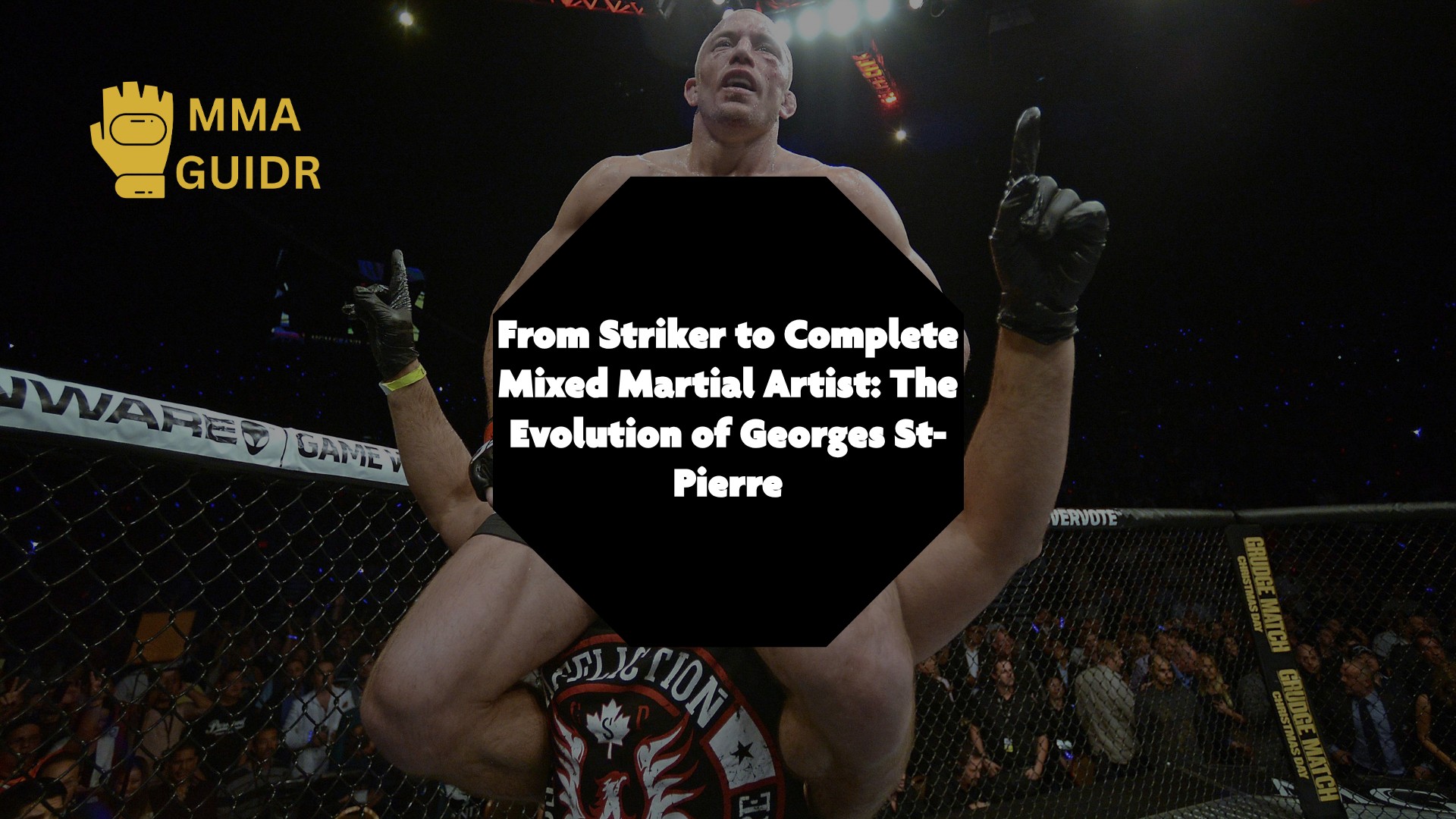
Georges “Rush” St-Pierre is widely regarded as the definitive blueprint for the modern mixed martial artist. While today’s fighters are expected to be proficient in all areas of combat from the beginning of their careers, St-Pierre’s era was still heavily defined by single-discipline specialists. What separated the Canadian champion from his peers was his unprecedented evolution. Beginning his martial arts journey as a Kyokushin karate practitioner, St-Pierre systematically transformed himself into the most dominant wrestler and well-rounded tactician in UFC welterweight history.
His career is a masterclass in adaptation, strategic cross-training, and the seamless blending of striking and grappling. By analyzing the mechanics of his evolution, we can understand how St-Pierre dismantled a generation of elite challengers and set a new standard for championship dominance.
The Kyokushin Karate Foundation
St-Pierre began training in Kyokushin karate at age seven, primarily to defend himself against school bullies. He eventually earned a 3rd Dan black belt, and this striking foundation deeply influenced his early MMA career. In his initial bouts, St-Pierre relied heavily on explosive athleticism, raw instincts, and karate-based kicking.
While he would later become known for his wrestling, his Kyokushin background provided a crucial framework for his entire game: elite distance management. Karate practitioners excel at darting in and out of range, utilizing a bouncing, bladed stance to control the space between themselves and their opponents. St-Pierre adapted this footwork for the cage, allowing him to dictate exactly where the fight took place and making him incredibly difficult to hit clean.
The Catalysts for Change: Hughes and Serra
St-Pierre’s evolution was not entirely proactive; it was forged through the fires of his two career defeats. At UFC 50, a young St-Pierre suffered a submission loss to the veteran champion Matt Hughes. The defeat exposed gaps in his grappling and submission defense against a high-level collegiate wrestler.
The second, and perhaps most significant, turning point was his shocking knockout loss to Matt Serra at UFC 69. Caught in a wild exchange, St-Pierre learned a harsh lesson about the inherent volatility of striking in four-ounce gloves. These two losses served as the primary catalysts for his transformation into a highly tactical, risk-averse, wrestling-heavy fighter who prioritized neutralizing his opponents’ strengths over chasing reckless finishes.
Pioneering the Modular Training Camp
Before St-Pierre, most fighters remained loyal to a single gym and a single head coach. St-Pierre was one of the first champions to pioneer the “modular” training camp, traveling extensively to train with world-class specialists in specific disciplines.
While Firas Zahabi at Tristar Gym served as his head coach and primary orchestrator, St-Pierre’s network was vast. He utilized Greg Jackson for overarching fight strategy, John Danaher and Renzo Gracie for Brazilian Jiu-Jitsu, Freddie Roach for boxing mechanics, and the Canadian Olympic Wrestling team for takedown proficiency. This collaborative approach ensured that St-Pierre was receiving the highest level of instruction in every individual facet of MMA, which Zahabi would then help synthesize into a cohesive game plan.
Developing Elite “MMA Wrestling”
One of the most persistent anomalies of St-Pierre’s career is that he retired with some of the highest wrestling statistics in UFC history—including 90 takedowns landed and a 73.8% takedown accuracy rate—despite having no high school or collegiate wrestling background.
St-Pierre did not learn traditional scholastic wrestling; he learned “MMA wrestling.” By training with Olympians and adapting their techniques for the cage, he developed a devastating blast double-leg takedown. His success lay in the setup. Because he had no wrestling pedigree, opponents often underestimated his level changes. St-Pierre mastered the art of reactive takedowns, perfectly timing his entries as his opponents committed their weight forward to strike, as famously demonstrated in his dominant victory over dangerous Muay Thai striker Thiago Alves at UFC 100.
The Piston Jab and Distance Control
As his career progressed, St-Pierre’s striking evolved from flashy karate kicks to highly efficient, fundamental boxing. Under the tutelage of Freddie Roach, he developed a piston-like lead jab that became the cornerstone of his stand-up game.
This jab served multiple mechanical purposes:
- Vision Obscurement: It constantly snapped the opponent’s head back, disrupting their line of sight and making it difficult for them to read St-Pierre’s level changes.
- Weight Displacement: A heavy jab forces an opponent to shift their weight to their rear leg, compromising their hips and making them highly susceptible to takedowns.
- Damage Accumulation: When facing elite wrestlers where takedowns were risky, St-Pierre could win fights entirely on the feet. Against NCAA Division I National Champion Josh Koscheck at UFC 124, St-Pierre abandoned his wrestling and used his jab to break Koscheck’s orbital bone, showcasing his ability to pivot to a striking specialist when necessary.
Ground-and-Pound and Positional Dominance
Once the fight hit the mat, St-Pierre’s approach to Brazilian Jiu-Jitsu was heavily modified for the realities of modern MMA. Guided by John Danaher and Firas Zahabi, St-Pierre moved away from hunting for risky submissions from the bottom, which could result in losing position. Instead, he focused on absolute positional dominance, guard passing, and punishing ground-and-pound.
He became a master of the “half-guard ride.” Rather than rushing to mount, St-Pierre would often intentionally flatten opponents out in half-guard. This position allowed him to pin their hips to the mat, control their posture, and deliver devastating elbows and punches while remaining relatively safe from sweeps or submission attempts. This grueling top-control game was designed to break an opponent’s will over the course of a five-round championship fight.
The Legacy of a Complete Champion
A common misconception during the latter half of St-Pierre’s title reign was that he was a “boring” or overly conservative fighter due to his string of decision victories. In reality, this was the byproduct of fighting the absolute elite of the welterweight division. St-Pierre employed a low-risk, high-reward strategy designed to completely dismantle the specific strengths of highly dangerous challengers.
If an opponent was a world-class striker, St-Pierre out-wrestled them. If they were a world-class wrestler, he out-struck them. By bridging the gap between traditional martial arts and modern, cross-disciplinary training, Georges St-Pierre proved that the future of the sport did not belong to the master of one trade, but to the master of all.