Step into any MMA gym, and you will likely see rows of orthodox fighters sparring other orthodox fighters. They trade jabs, circle to their left, and fall into a comfortable rhythm. But the moment a left-handed fighter steps into the cage, that rhythm shatters. Angles disappear, safe zones become danger zones, and the usual jab-cross combinations fail to land. This is the “Southpaw Advantage,” a strategic edge that has propelled fighters like Anderson Silva and Conor McGregor to legendary status.
The Geometry of the Fight: Closed vs. Open Stance
To understand why southpaws confuse their opponents, you must understand the geometry of combat. In a standard match where two right-handed fighters face off, they are in a Closed Stance. Their lead left hands are on the same side, creating a barrier that makes landing a rear power shot difficult without setting it up first.
When a southpaw faces an orthodox fighter, they enter an Open Stance. The fighters are mirror images of each other. This alignment removes the lead-shoulder barrier, creating a direct path for the rear power hand—the straight left for the southpaw and the straight right for the orthodox fighter. While this opening technically exists for both athletes, the southpaw lives in this world. They train almost exclusively against orthodox partners, mastering the timing and angles of the open stance. The orthodox fighter, however, encounters this puzzle rarely, often leading to hesitation and tactical errors.
The Golden Rule: Winning the Lead Foot Battle
If you take only one lesson from studying the Southpaw stance, it should be the battle for the outside foot position. In an open stance matchup, the fighter who places their lead foot to the outside of their opponent’s lead foot gains a dominant geometric advantage.
- Offensive Advantage: When your lead foot is outside, your rear shoulder aligns directly with your opponent’s centerline. This creates a clear channel for your power hand (the straight left) to land flush on the chin.
- Defensive Advantage: Stepping outside takes your head off the centerline and moves your body away from your opponent’s rear power hand. You are effectively flanking them, forcing them to pivot before they can return fire.
This constant jockeying for position—often called “The T-Position”—dictates the flow of the fight. If a southpaw allows their foot to drift inside, they become vulnerable to the orthodox fighter’s straight right. But when they secure the outside angle, they can unleash their most dangerous weapons with impunity.
Key Weapons of the Southpaw Arsenal
The open stance enables specific strikes that are difficult to execute in a closed stance matchup. Mastering these weapons is essential for any fighter looking to exploit the southpaw advantage.
The Double Attack
The open stance creates a “Pick Your Poison” scenario known as the double attack. Because the fighters’ bodies are open to each other, the southpaw’s rear side has a direct line to both the head and the body.
A classic example is the “Cro Cop” dilemma, named after the legendary Mirko Cro Cop. He would threaten the straight left hand down the pipe. If the opponent kept their guard tight to block the punch, their midsection and ribs were exposed for the left roundhouse kick. If they dropped their elbow to protect their ribs, the straight left would pierce through the guard. This dual threat forces the orthodox fighter to constantly guess high or low, often reacting too late to stop the damage.
The Liver Kick: Anatomy of a Fight-Ender
Perhaps the most devastating weapon available to a southpaw is the left roundhouse kick to the liver. The human liver shot is one of the most painful and debilitating strikes in combat sports.
Anatomically, the liver is located on the right side of the abdomen, just below the ribcage. In a closed stance (orthodox vs. orthodox), a rear roundhouse kick targets the opponent’s left side (the spleen/stomach area), which is less sensitive. However, in an open stance, the southpaw’s rear left leg is perfectly aligned with the orthodox fighter’s right side—the home of the liver.
A well-placed left kick does not need to be full power to end a fight. The impact on the liver triggers an autonomic nervous system response, causing a sudden drop in blood pressure and temporary paralysis. Fighters who have absorbed massive head trauma often crumble instantly from a clean shin to the liver.
Legends Who Defined the Stance
History is filled with fighters who used the southpaw stance to confound and conquer the best in the world. Analyzing their careers reveals different approaches to the same geometric advantages.
Anderson Silva: The Matrix
For years, Anderson Silva ruled the middleweight division with a style that seemed to defy physics. Silva often kept his hands low, inviting opponents to strike. He used the open stance to bait orthodox fighters into throwing the jab, which he would slip effortlessly before countering with surgical precision. His mastery of distance allowed him to land front kicks and knees that orthodox opponents never saw coming.
Conor McGregor: The Celtic Cross
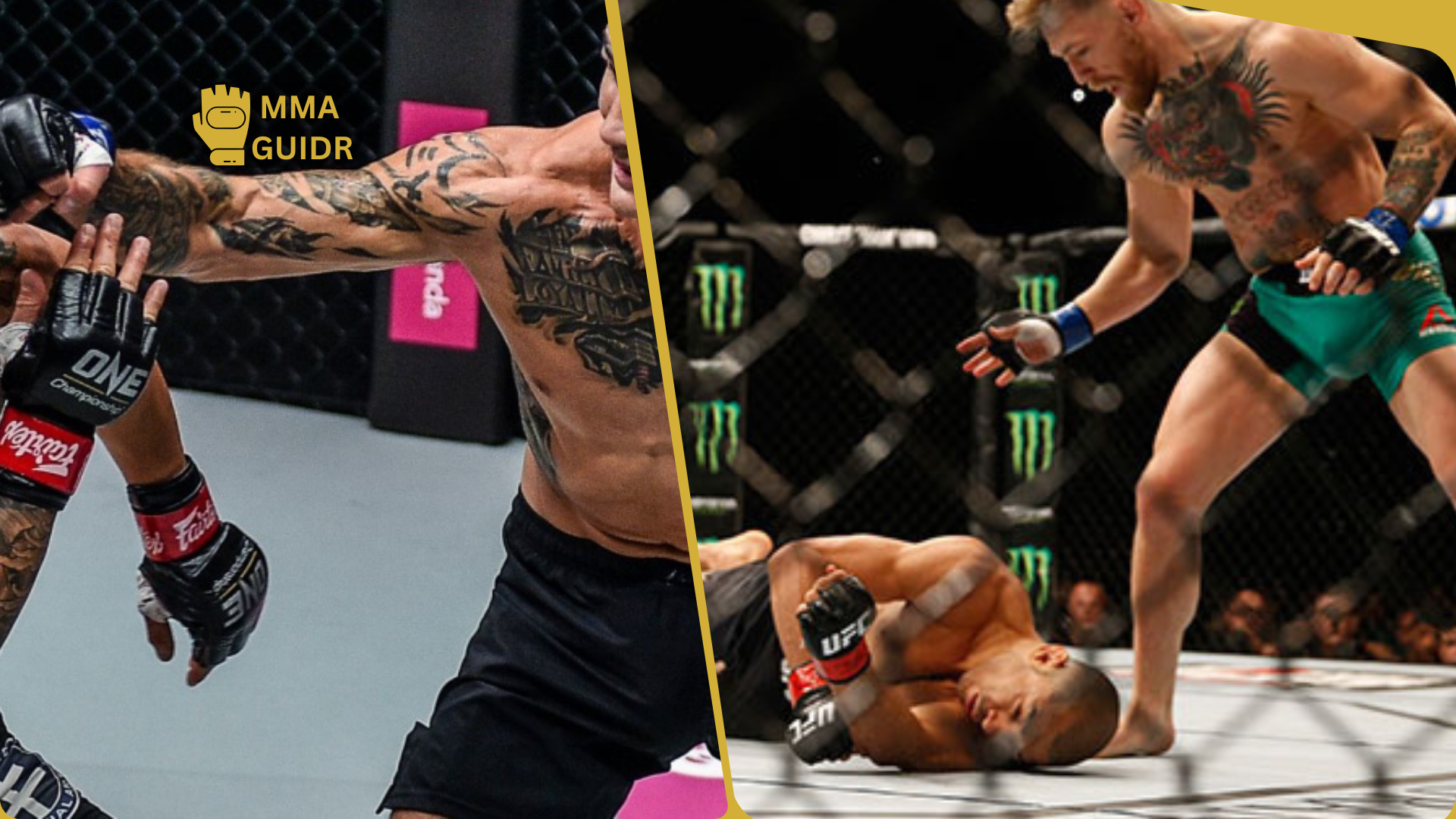
Few fighters have utilized the “outside foot” concept as effectively as Conor McGregor. In his prime featherweight run, McGregor’s entire game plan revolved around creating the angle for his straight left hand. He would pressure opponents against the cage, step his lead foot outside, and fire the “Celtic Cross” down the center. His knockout of Jose Aldo is a textbook example of open stance timing—slipping an orthodox attack to land the counter left.
How to Fight a Southpaw: Strategies for Orthodox Fighters
Fighting a southpaw requires a complete strategic overhaul. Orthodox fighters who try to “box as usual” often wake up looking at the referee’s flashlight. Here is how to neutralize the advantage:
- Mirror the Footwork: You must aggressively fight for the outside foot position. If the southpaw steps left, you must step right. Deny them the angle.
- The Low Outside Calf Kick: The open stance exposes the southpaw’s lead calf. A hard low kick to the outside of their lead leg is difficult to check and can compromise their mobility early in the fight.
- The Straight Right: Just as the southpaw has a lane for their straight left, you have a lane for your straight right. It is the most effective punch against a left-hander. Forget the jab; lead with the cross or throw the straight right immediately after a hand trap.
- Wrestling Tactics: The open stance places the southpaw’s lead leg close to your lead hand. This makes the “Low Single” or “Ankle Pick” highly effective. Fighters like Georges St-Pierre utilized this to ground southpaw strikers before they could settle into a rhythm.
Conclusion
The Southpaw Advantage is not a myth; it is a tactical reality born from geometry and scarcity. While modern MMA training has improved, and fighters are better prepared for left-handed opponents than they were in the early days of the UFC, the open stance remains a chaotic battlefield. Whether you are a natural lefty looking to sharpen your tools or an orthodox fighter trying to solve the puzzle, mastering the dynamics of the open stance is mandatory for elite performance. In the cage, the fighter who understands the angles controls the fight.
FAQ
Is the southpaw stance always better?
Not necessarily. While southpaws enjoy the element of surprise and unfamiliarity, the open stance works both ways. A skilled orthodox fighter who understands the geometry can hit the southpaw just as hard with their own straight right hand. The “advantage” comes primarily from the southpaw having more experience in the open stance than their orthodox opponent.
Can a right-handed person fight southpaw?
Yes. These are often called “converted southpaws.” Fighters like Marvin Hagler in boxing or even Jon Jones in MMA frequently switch stances. Fighting southpaw as a right-handed person places your dominant hand in the lead, giving you a powerful jab and hook, though it may reduce the power of your rear straight punch.
What is the biggest mistake orthodox fighters make against southpaws?
The most common error is circling into the southpaw’s power hand. Orthodox fighters are conditioned to circle to their left (away from an orthodox opponent’s right hand). Against a southpaw, circling left moves them directly into the path of the dangerous straight left and left roundhouse kick. Orthodox fighters must learn to circle right (outside the lead foot) to stay safe.
Why are liver kicks more common against southpaws?
Actually, liver kicks are more common from southpaws. Because the liver is on the right side of the body, a southpaw’s left kick targets it directly in an open stance. For an orthodox fighter to hit a southpaw’s liver, they usually have to use a spinning back kick or a switch kick, which are slower and harder to land than a simple rear roundhouse.