Mixed Martial Arts is a complex, fast-paced sport that blends techniques from disciplines across the globe. For new fans, listening to the commentary can sometimes feel like trying to understand a foreign language. Broadcasters frequently fire off terms like “underhooks,” “pummeling,” and “check hooks” in the heat of the action. Understanding this technical jargon is the key to transitioning from a casual viewer to an educated fan who can appreciate the intricate chess match happening inside the cage.
The terminology of MMA is a linguistic melting pot, drawing heavily from wrestling, Brazilian Jiu-Jitsu (BJJ), boxing, and Muay Thai. This guide breaks down the essential striking and grappling terms you need to know to decode the commentary and understand the mechanics of the sport.
The Clinch and Wrestling Fundamentals
When fighters close the distance and grab hold of each other while still standing, they enter the clinch. This is where wrestling terminology takes over, and the battle for leverage begins.
- Underhook: A foundational clinch hold where a fighter places their arm underneath their opponent’s arm and wraps it around their midsection or back. Securing an underhook provides significant leverage for takedowns, allows a fighter to control their opponent against the cage, and aids in standing back up if taken down.
- Overhook (Whizzer): The direct counter to an underhook. A fighter wraps their arm over the top of their opponent’s underhooking arm. It is primarily used defensively to crank the opponent’s shoulder, prevent takedowns, or set up defensive throws.
- Pummeling: The continuous, fluid motion of fighting for underhooks in a standing clinch. Fighters “swim” their arms inside their opponent’s arms to gain a dominant double-underhook position. In the early days of MMA, the fighter who won the pummeling battle almost always dictated where the fight took place.
Takedown Defense and Mat Control
A striker’s best friend against a high-level wrestler is their ability to stay on their feet. This requires specific defensive wrestling techniques.
- Sprawl: A defensive wrestling technique used to avoid a leg-grab takedown, such as a double-leg or single-leg. The defending fighter drops their hips heavily to the mat and kicks their legs backward, placing their full body weight on the attacking opponent’s upper body. This exhausts the grappler and keeps the fight in striking range, a strategy often referred to as “sprawl and brawl.”
Brazilian Jiu-Jitsu Ground Positions
Before the popularization of BJJ in the early 1990s, being on your back in a fight was considered a universally losing position. The BJJ lexicon introduced the concept that a fighter could actively attack and defend from their back, fundamentally changing how fights are scored and analyzed.
- Guard: A foundational BJJ position where a fighter is on their back but uses their legs to control the opponent on top. Variations include the closed guard (legs locked around the opponent’s waist), open guard (legs uncrossed and actively framing), and half-guard (controlling only one of the opponent’s legs).
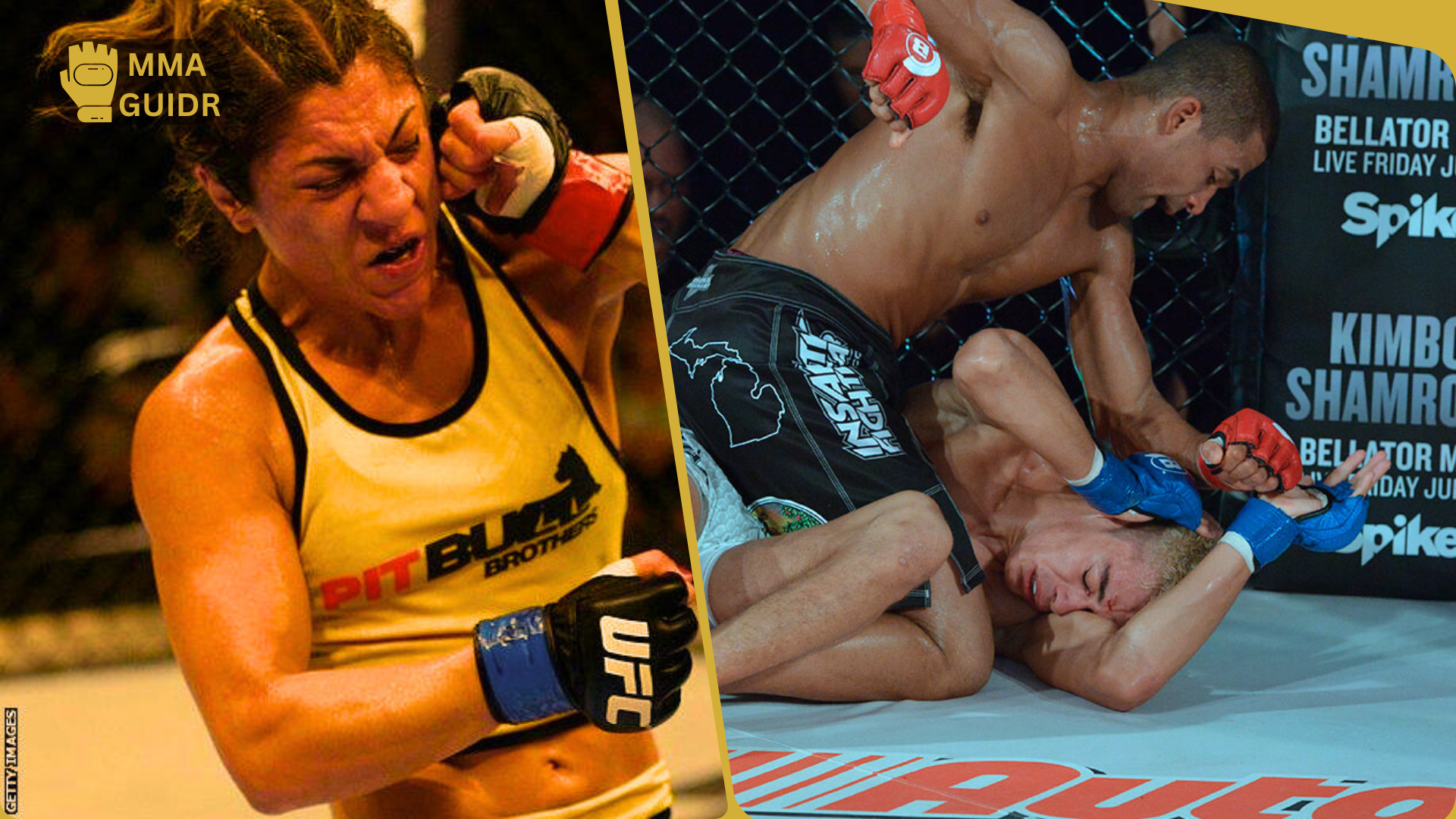
- Mount: A dominant grappling position where a fighter sits directly on top of their opponent’s torso, pinning them to the ground. This position allows for unobstructed ground-and-pound strikes or the setup of fight-ending submissions.
Essential Boxing Mechanics in MMA
While MMA striking incorporates kicks, knees, and elbows, traditional boxing mechanics remain the primary way fighters manage distance and inflict damage with their hands.
- Jab: A quick, straight punch thrown with the lead hand. It is the most important punch in combat sports, used to measure distance, set up heavier combinations, and disrupt the opponent’s timing and forward pressure.
- Cross: A powerful straight punch thrown with the rear hand. It generates massive force from the rotation of the fighter’s hips and shoulders.
- Overhand: A looping, arcing punch thrown with the rear hand over the top of the opponent’s guard. It is a staple in MMA, especially for shorter fighters trying to close the distance against taller opponents or wrestlers looking to land a concussive blow while changing levels.
- Check Hook: A highly technical counter-strike. A fighter throws a lead hook while simultaneously pivoting on their lead foot to swing their back leg out of the way of an advancing opponent. It uses the opponent’s forward momentum against them while creating a safe angle for escape.
Muay Thai Influence on Striking
Muay Thai, the “Art of Eight Limbs,” provides MMA with its most devastating kicks, knees, and elbows. One of the most frequently referenced techniques is essential for distance management.
- Teep (Push Kick): A linear front kick originating from Muay Thai. Rather than snapping upward to cause blunt force trauma to the head, the teep is thrust forward to push an opponent away, manage distance, or target the midsection to disrupt the opponent’s breathing and forward momentum.
Clearing Up Common Misconceptions
Because MMA borrows words from various martial arts and standard English, casual viewers often misinterpret certain terms. Here are a few common mix-ups to avoid:
- Overhook vs. Overhand: New fans frequently confuse these two terms. An overhook is a grappling tie-up used in the clinch to control an opponent’s arm and posture. An overhand is a looping, concussive punch thrown with the rear hand.
- The Meaning of “Guard”: In boxing or kickboxing, “keeping your guard up” refers to holding your hands high to protect your head. However, in MMA commentary, being “in the guard” almost exclusively refers to the Brazilian Jiu-Jitsu ground position where the bottom fighter has their legs wrapped around the top fighter.
- Pummeling as Striking: Because the word “pummel” in standard English means to strike repeatedly, casual viewers often assume “pummeling” refers to ground-and-pound or a flurry of punches. In MMA terminology, it strictly refers to the grappling battle for underhooks in the clinch.